
Preservation

I was in St. Louis for several days last week, attending a conference. And I came away – as I usually do – with some thoughts about the real estate market.
 
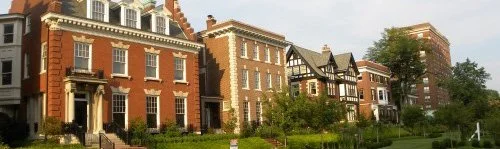
I stayed in the Central West End, a vibrant, walkable mid-town area, filled with cool places to eat, drink, and shop. Also filled with great houses that have survived since the turn of the last century. Huge, ornate, fabulous houses – a testament to the wealth accumulated in a city that got big and got rich 150 years ago. It feels like a mashup of Centennial Park, Hillsboro Village, and Five Points – but with bigger fancier houses. Much bigger, much fancier, and some cool Art Deco, and mid-20th century buildings thrown in for spice. I loved it! 
 
Nashville, like all American cities that existed 150 years ago, had its share of areas like Central West End. Most of what Nashville once had is gone. Nashville was much smaller than St. Louis, of course, so there was less of it to begin with, but the big difference is the state of preservation. The Central West End survived largely intact. Similar parts of Nashville did not.
 
So, what does this have to do with our current real estate market? It has to do with how value builds over time. I’m taking the long view here. Bear with me.
We live in an instant gratification world. People want the latest thing – right now. Everything is in present tense. But I see a lot of renovation and modernization projects these days that may turn into a drag on market value down the road.
 
I’m not trying to stop the clock. Change is inevitable, and I do believe that everyone should have the house they want – and have it right now. But ... 
 
There are things I’d think long and hard about before doing them to a house:
 
Painted Brick Paint is touted as a quick, (relatively) cheap, easy way to make an old brick house new, but it comes with a downside. Unlike wood, brick is made to withstand weather without paint. Adding a layer of paint introduces an unnecessary maintenance issue. Further, it fundamentally changes the character of the house. Ranches and Tudors weren’t intended to be black. Or white with black trim. Or blue. Plus, who wants to pay for a new paint job 15 years from now?

Open Concept It seems that everyone wants to live in the kitchen these days. Sofa, easy chairs, coffee table, big screen TV, dining table, frying pan, toaster, and fridge – all in one room, along with noise, conversation, splatters and spills. That’s fine if you want it, but I predict that someday people will want some of their walls back – for a bit of privacy and noise abatement if nothing else. 
 
There are other points I could make, but I think I’ve made the main one: think twice before fundamentally altering the character of your house. The key to the wonderfulness of the Central West End is that the houses have largely been left alone. I’m sure there are lots of new kitchens (see my exemption below) and new bathrooms, and I hope they all have central HVAC. But the look and feel of the neighborhood remains, and that’s what makes it vibrant – and valuable. 
 
Exemption: Kitchens. I believe everyone on earth should have their dream kitchen. Technology and techniques have changed radically over the past century, and it would be burdensome, not to mention a bit silly, to preserve and use an antique kitchen. So, have at it! Redo the kitchen – I did mine in my 1962 ranch two years ago – but be very careful with the rest of the house. 

Everybody’s Cranky

Nobody’s happy these days. 
 
As the residential market begins to tip in favor of buyers for the first time in more than a decade, everyone involved – buyers, sellers, and their realtors alike – is unsettled and unhappy.
 
Inventory is up, days on the market are up, price inflation has slowed to a crawl and in some cases is even declining. Reductions on listing prices have become the norm. That sellers are unhappy is pretty understandable. 
 
But buyers are cranky as well. Many still pine for the days of 3% interest. And because of ongoing inflation, there is talk of the Fed bumping the rate this fall – which will eventually affect mortgage rates. In what should clearly be a wonderful time to buy a house, some are still actually waiting for rates to drop. Spoiler alert: they won’t.
 
Realtors are trying to span this chasm between clients’ desires and market realities, and get the deals done. That can be challenging.

So, what do we do with all this? We can start by accepting some hard truths:
 
If you want to do a deal, now is always the best time. Residential real estate is an investment, but it is much more about where and how you live your life than it is about money. If you need to buy or sell right now, why limit your life in other ways by waiting for market improvements that may or may not come.
 
Trying to game the market almost never works. Waiting for rates or prices to drop is at best a crap shoot. You might get lucky – rates could go down, and/or inventory could go up – but you might not. If you need or want to buy or sell, why wait on the sidelines and deny yourself the benefits of doing a deal on the chance you’ll get a better deal at some undefined point in the future? 

There is absolutely no guarantee that you will sell your house for more than you paid for it. Despite short-term ups and downs, property values have steadily increased over time, and playing the long game – holding onto a property for decades – usually results in financial gain. But you may not have decades to hold on. Maybe you need a bigger house, or a house in a new city or state – right now. The current market may deny you a profit. 
 
Moaning about realities you can’t change doesn’t help. I have clients who will be listing their house next week at $5,000 less than they paid for it four years ago. I just closed a seller at $9,000 less than he paid for his house – also four years ago, at the end of the biggest year-on-year price escalation in recent memory. Disappointing, of course! But they are aware that the market rules and that they had a good run living and working in their houses. Eyes clear, chin up, do the deal, and move on to the next chapter without dwelling on the loss. 

Anniversary

On the 4th of July, 2026 I marked the 50th anniversary of my move to Nashville. 
 
I came here from my hometown, Atlanta, which had during my lifetime become a thriving, throbbing, buzzing metropolis, full of energy and forward motion, with something new and exciting – or so it seemed to me – happening every day. 
 
The Nashville I came to was a medium-sized city, still operating like a small town. Sleepy and skeptical of outside influences. Set in its ways, stubbornly so. Still fighting the Civil War – something Atlanta seemed to have given up decades before. 
 
For my part, I was a green, not-all-that-mature, 24-year-old, fresh from graduate school, with a head full of what I “knew” to be true. I wasn’t impressed by Nashville and thought I’d stay here about 15 minutes … 
 
Well. That was then, now is now, and how things have changed! Nashville and I grew up together, and we are both better for it! I love my adopted hometown, and it looks like I’m here for the duration.
 
Along the way, what did we learn?

Nothing’s permanent Change is the only constant there is. If you don’t like the way things are in the moment, hang on tight and something will happen. I was young and inexperienced 50 years ago. I am neither one of those things now. I’m much more mature and I’m a lot smarter, not unlike Nashville these days. Applying this to real estate: If you don’t like where you are living, make a move. If you can’t make the move you want to right now, work toward the goal while enjoying your current situation as you can. Look forward, not back, and move ahead.
 
Play the long game In global terms, 50 years is but a blip. But it represents the vast majority of my life on this planet, and a fairly good chunk of Nashville history. In real estate, 50 years is more than forever. Quick returns are hard to come by – even in a fast market, which this definitely is not! If you’re wanting to sell at a gain, hold on for the ride. Not 50 years necessarily, but probably at least five. 
 
Change can involve both gain and loss As Nashville has grown, we have lost certain things of value: that small-town feeling, a number of significant historic buildings, relatively manageable traffic. And we have gained others: Excellent food and retail options, a lively entertainment scene, thriving historic neighborhoods, a diverse population, an international airport. For my part, I’ve gained perspective and wisdom, but also achy joints, nascent love handles, and an ability to easily forget things I used to easily remember. Real estate can be the same. There are wins and losses. In spite of what we want to believe, there’s nothing in the US Constitution that guarantees a profit when you sell a house. Sometimes you make money, sometimes you lose a little. But the gain is shelter from the storm and a place to live your life and grow into who you are today. 

Pride

June is (or was, depending on when you read this) international Pride Month.
 
Beginning in 1970 to commemorate the Stonewall uprising, which had occurred the year prior in New York, Pride has grown from events in four US cities into an international observance – a month for LGBTQ+ people to stand up and be counted. To assert their personhood. To demand – still working on this one – a full place at the table.
 
It’s always great to be a part of Nashville Pride, and this year was no exception. Following the march down Broadway to the riverfront, I worked a shift at my church’s booth at the celebration on Bicentennial Mall with some of my fellow parishioners. As always, the mall was mobbed, and the fashion statements were jaw-dropping. Our booth offered water, handed out fans and streamers, and let people who might be doubting know that there is a place for them – at least there is with us. 
 
As always, I went home after my shift in the booth, about to die of the heat, but feeling happy. And – as always – thinking about real estate. 

So, looking for the Pride/real estate overlap, the following …

It’s about life – and how you want to live it. I’ve said it a number of times in this space – your house is the place where you “do” your life. Your house is a part of your identity, a reflection of what makes you, you. Living how you like and where you like is part of the Out and Proud equation.
 
It’s about taking care of yourself. Owning your authentic identity is self-care. So is owning your own house. Paying your own mortgage rather than someone else’s. Building equity for the future. Painting, decorating, landscaping to suit yourself – all part of making your life authentic and the best it can be.
 
It’s about freedom. Owning your identity is about freedom from having to hide who you are. Freedom from stereotypes and societally determined norms. Owning your own house means freedom from ever-escalating rent, from potential whims of a landlord, and from ending up with nothing to show for it after spending your life paying rent. 
 
I’m proud to be out. I’m proud to be a realtor. And I’m always proud to help out if you need real estate counsel. 

Bad Tire Karma

As I write this, I am sitting in the waiting room at Discount Tire on Charlotte Avenue. They are plugging a slow leak in the right rear tire. This is the eighth flat I’ve had in this car – which I have owned for just under five years.

In 1984, when cars came with five full-sized tires, I bought a brand-new Volkswagen Jetta. Within six months, I had picked up a nail in all five of those tries.

My 2012 Mercedes Benz came with one of those little donut spares that are designed to last for about 150 miles max. I had so many flats in that car, the donut wore out. One day while the donut was on the car waiting for yet another flat to be repaired, it gave up the fight and spontaneously blew out. Loud bang! No more donut!

I could tell you more – like about the 1976 Fiat that arrived on our shores with 4 defective tires that had to be replaced within the first year I owned it – but I think I’ve made my point.

I have bad tire karma.

This has been going on since the early 1970s, so I’m (sorta) used to it. And of course, I relate everything in my world to the real estate business, so how about a few insights …

Be prepared for the unexpected (or in my case the semi-unexpected). My current car, a BMW, has no spare at all – not even a donut. I never know when or where my next flat will occur, so I keep my AAA membership current, and I keep a small electric tire pump in the trunk. In the course of a real estate deal almost anything can happen, and maintaining resources and work-arounds, is essential. I try to keep my wits about me and stay flexible. And I stay on good terms with my broker, my closing attorneys, and my go-to lenders.

Roll with the punches. As noted above, with tires and real estate, anything can, and often does, happen. Maintaining an active sense of adventure is helpful. Furthermore, moaning over setbacks – like being unable to get to a showing (because a tire had gone flat, and yes, this happened) or a deal falling apart because of a terrible inspection – is not helpful. Move ahead and look for something you might learn from the experience.  

Celebrate the victories! Roadblocks and setbacks are there to keep things interesting, to challenge us, and to make the eventual victory feel even sweeter. Nothing feels quite like cruising out of the lot at Discount Tires with 4 healthy, fully-inflated, tires. Likewise, nothing feels quite as sweet as sitting with a satisfied client at the closing table after a couple of surprises (shocks, even) on the way to closing.